How to Control Temperature on a Charcoal Grill
To control temperature on a charcoal grill, set the bottom vent for how much air the coals get and the top vent for how the heat moves, then adjust one vent at a time. Fewer lit coals and a small opening hold low heat, while a full chimney and wide vents push the fire hot.
On this page (9 sections)
- How does a charcoal grill make heat in the first place?
- How do you measure the temperature you're trying to control?
- How do the vents change the heat?
- How many coals should you light for the target heat?
- How do you set up two heat zones on one grill?
- What do you do when the grill runs too hot or too cold?
- How do you hold a low, steady temperature for a long cook?
- How do weather and fuel change the vent settings you need?
- How do you shut a charcoal grill down safely?
To control temperature on a charcoal grill, set the bottom vent for how much air the coals get and the top vent for how the heat moves, then adjust one vent at a time. Fewer lit coals and a small opening hold low heat, while a full chimney and wide vents push the fire hot.
The vent dance only works on a fire you built with a plan. How many coals you light, where you pile them, and whether the lid stays down matter more than a quick turn of a handle.
How does a charcoal grill make heat in the first place?
A charcoal grill makes heat when air reaches hot coals and the carbon in them burns. More air means a hotter fire, and less air means a cooler one, so your vents are the thermostat.
Charcoal needs oxygen to burn. Cut the airflow off at the bottom and the fire starves, which is why every grill has a bottom vent you can close for shutdown.
The top vent controls where smoke and hot air leave. A wide-open top pulls air up through the coal bed, while a nearly closed top holds heat and smoke inside the lid.
This is the reason one lever rarely fixes a temperature problem. If you open both vents wide, the fire climbs fast, and if you close both it drops, but you rarely need both moves at once.
Change one, wait, and see what the grill does.
How do you measure the temperature you're trying to control?
Read the grate, not the lid, because those two numbers often disagree. A lid gauge sits in rising air and can run 50 F or more off the actual cooking surface.
If your grill came with a gauge, treat it as a rough guide. For real control, you want a probe near the food, so add an analog thermometer if the lid has a hole for one.
It reads in Fahrenheit and Celsius up to 700 F and uses a wing nut. Weber says the tab on the back locks the dial into place on the bezel, and the bezel is sold separately, so check the fit on your lid first.
If your lid has no hole, a pair of dial thermometers that mount through a 3/8 in hole is another route. Whatever you use, know how far it sits from the food before you trust the reading.
How do the vents change the heat?
The bottom vent is the main power control and the top vent is the fine trim. Open the bottom to feed the fire and close it to calm the fire.
Think of the bottom vent as the throttle. Cracking it a quarter open slows the burn, and opening it wide makes the coals glow.
The top vent should usually sit at least partway open, because it keeps smoke moving and stops ash from choking the fire. On most cooks it stays wide for high heat and narrows for a long, slow burn, but never all the way shut while food is on.
Make one change and give it 5 minutes. The coals, the metal, and the air inside all take time to settle, and a second tweak before the first one works just sends you chasing swings.
How many coals should you light for the target heat?
Count the chimney load before you ever touch a vent, because the coal bed sets the ceiling you can reach. A full layer across the basket runs hot, while a single layer on one side stays mild.
The Amazon Basics chimney holds up to 6.6 lb of charcoal, briquettes, or hardwoods, which is enough for a full coal bed in a standard kettle or full-size grill. Its 10.8 x 6.7 x 10.8 in body and cool-touch handle make it a simple way to light a measured load.
A common split is about a half-full chimney for 300 to 350 F cooks and a full one for searing. Old coals plus a fresh top-up run cooler than all-new coals.
If you want a bigger coal bed for a crowd, an extra large charcoal grill gives you more floor to spread the fire across, which makes the low end easier to hold.
How do you set up two heat zones on one grill?
Bank the coals on one side and leave the other side empty. That gives you a hot zone for searing and a cool zone for finishing, and you move food between them.
Banking keeps the fire concentrated, so you can sear over the coals and slide a piece to the empty side to coast. A drip pan under the cool side catches juices and keeps the fire from flaring.
Set the lid vent over the cool side on most cooks. That pulls hot air across the food and gives you a gentler, more even cook than having the vent sit right over the coals.
Two-zone setups suit chicken, thick pork chops, and anything that needs a crust first and a slow finish. They also make a grill feel bigger than it is, since you get two heat levels from one fire.
What do you do when the grill runs too hot or too cold?
Cut the bottom vent by half and wait when it runs hot; open it wide when it runs cold. Small, single changes settle the fire faster than big corrections.
If the heat climbs too high
Close the bottom vent in stages rather than slamming it shut, or the fire can stall and smoke bitter. Move food to the cool side if you have one, and keep the lid down so you aren't feeding the coals extra air.
If the fire fades
Open the bottom vent fully and tap ash off the coals with long tongs. Stuck ash is a common reason a fire looks dead but still has fuel.
If that doesn't work, add a few lit coals rather than a pile of unlit ones.
How do you hold a low, steady temperature for a long cook?
Use a small, well-banked coal bed, keep the bottom vent nearly closed, and bury a few wood chunks. You're aiming for a fire that idles rather than roars.
Start with fewer lit coals than you think and let the fire grow into the space. Add a small handful of fresh coals when the temperature starts to dip, rather than dumping a large load that spikes the heat.
Check the grate every 30 to 45 minutes with a dial like the YOTOM pair. Each 2 in stainless dial mounts through a 3/8 in hole with a wing nut, reads 100 to 800 F, and has a fog-free lens, which helps on long, steamy cooks.
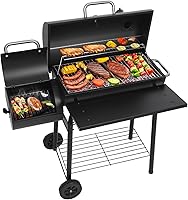
Long, slow cooks are where a charcoal grill with offset smoker setup earns its keep, since the side box lets you feed fuel without lifting the main lid.
How do weather and fuel change the vent settings you need?
Wind, cold air, and damp charcoal all steal heat, so plan on more fuel and more air in bad weather. A grill that holds 350 F on a calm day may struggle to reach 300 in wind.
Set up out of the wind, or use a shield that doesn't block the vents. Cold weather means the coals work harder, so light a little extra and bank it well.
Dry charcoal lights and burns predictably. Damp briquettes smoke and smolder, so keep the bag sealed between cooks.
Lumpy hardwood charcoal heats faster and burns hotter than briquettes, which changes the vent range you'll work in.
How do you shut a charcoal grill down safely?
Close both vents all the way once the food is off, and leave the lid down. With no air, the coals die out and the remaining charcoal saves for the next cook.
Don't pour water on the fire unless you have to. It makes a mess of the ash pan and can crack hot metal.
Give the grill an hour or more to cool before you empty the ash.
That saved charcoal is your head start next time. Shake off the ash, add fresh coals, and you're back on the same coal count, which makes controlling temperature on a charcoal grill easier every cook.
If you're still picking a grill, the site's charcoal grill buyer's guide covers the sizes and layouts, and the charcoal grills with temperature control roundup shows which models make vent work easier.
Frequently asked questions
Should I leave the lid open or closed when I adjust the vents?
Close the lid, then leave the vents alone for about 5 minutes before judging the change. An open lid lets air rush past the coals, so the grill reads hot and you end up chasing a number the fire never held.
Why does my charcoal grill get hotter after I add fresh coals?
Unlit coals are still warming up, so a handful added over a steady fire will start to burn as the older coals die down. Add a small batch more often, or light the next round in a chimney before it goes in.
Can I grill with the lid off and still control heat?
You can, but the lid matters more than any other part. Without it the fire burns fast and the grate overheats, so keep the lid closed and open it only to turn food or check it.
What temperature should a charcoal grill read before I put food on?
Wait for the grate to settle at the target for the cook, roughly 225 to 275 F for slow cuts and 400 to 500 F for steaks. A reading that is still climbing will keep moving under the food.